



xgboost-distribution
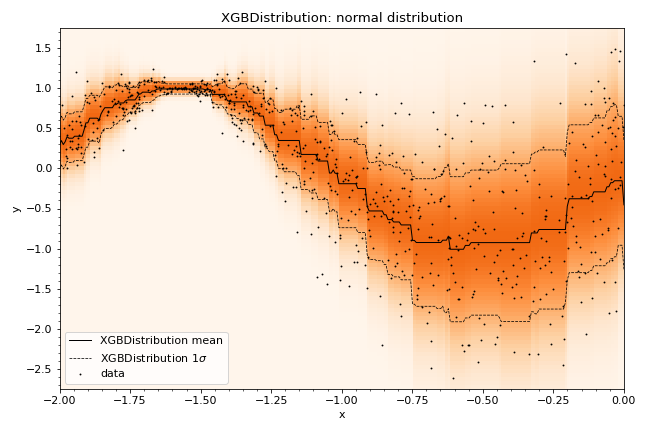
XGBoost for probabilistic prediction. Like NGBoost, but faster, and in the XGBoost scikit-learn API.
Installation
$ pip install xgboost-distribution
python_requires = >=3.8

install_requires =
    scikit-learn
    xgboost>=2.0.0
Usage
XGBDistribution follows the XGBoost scikit-learn API, with an additional keyword
argument specifying the distribution, which is fit via Maximum Likelihood Estimation:
from sklearn.datasets import fetch_california_housing
from sklearn.model_selection import train_test_split

from xgboost_distribution import XGBDistribution


data = fetch_california_housing()
X, y = data.data, data.target
X_train, X_test, y_train, y_test = train_test_split(X, y)

model = XGBDistribution(
    distribution="normal",
    n_estimators=500,
    early_stopping_rounds=10
)
model.fit(X_train, y_train, eval_set=[(X_test, y_test)])
See the documentation for all available distributions.
After fitting, we can predict the parameters of the distribution:
preds = model.predict(X_test)
mean, std = preds.loc, preds.scale
Note that this returned a namedtuple of numpy arrays for each parameter of the distribution (we use the scipy stats naming conventions for the parameters, see e.g. scipy.stats.norm for the normal distribution).
NGBoost performance comparison
XGBDistribution follows the method shown in the NGBoost library, using natural
gradients to estimate the parameters of the distribution.
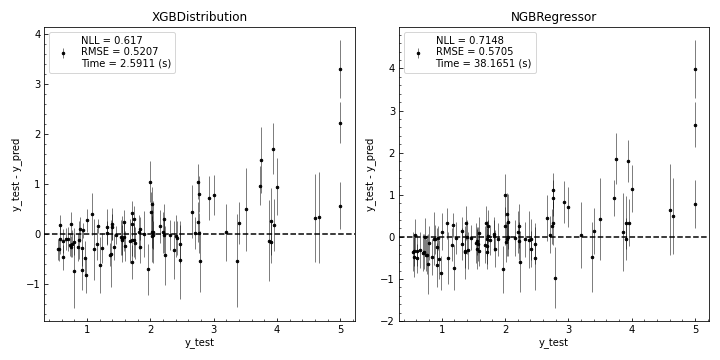
Below, we show a performance comparison of XGBDistribution and the NGBoost
NGBRegressor, using the California Housing dataset, estimating normal distributions.
While the performance of the two models is fairly similar (measured on negative
log-likelihood of a normal distribution and the RMSE), XGBDistribution is around
15x faster (timed on both fit and predict steps):
Please see the experiments page for results across various datasets.
Full XGBoost features
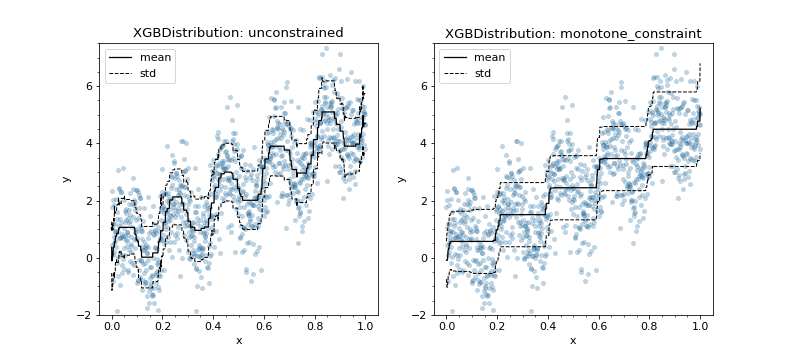
XGBDistribution offers the full set of XGBoost features available in the
XGBoost scikit-learn API, allowing, for example, probabilistic regression
with monotonic constraints:
Acknowledgements
This package would not exist without the excellent work from:
NGBoost - Which demonstrated how gradient boosting with natural gradients can be used to estimate parameters of distributions. Much of the gradient calculations code were adapted from there.
XGBoost - Which provides the gradient boosting algorithms used here, in particular the
sklearnAPIs were taken as a blue-print.
Note
This project has been set up using PyScaffold 4.0.1. For details and usage information on PyScaffold see https://pyscaffold.org/.